





What Is a Tech Pack? A Complete Guide for Clothing and Fashion Production

Reviewed and last updated on August 29, 2026 by admin
A great clothing idea can begin with something as simple as a sketch on paper. Turning that sketch into a garment that a manufacturer can reproduce accurately is a very different challenge.
A factory needs to know much more than what the finished item should look like. It needs exact measurements, fabric specifications, stitching instructions, colours, trims, labels, construction details and information about how each part of the product should come together.
That is where a tech pack becomes important.
So, what is a tech pack?
A tech pack, short for technical package, is a detailed set of production instructions that explains exactly how a product should be made. In fashion and clothing manufacturing, it acts as the communication link between the designer or brand and the factory.
Think of it as the blueprint for a garment.
Instead of expecting the manufacturer to interpret a sketch, the tech pack removes as much uncertainty as possible by documenting the technical details needed to turn the design into a repeatable physical product.
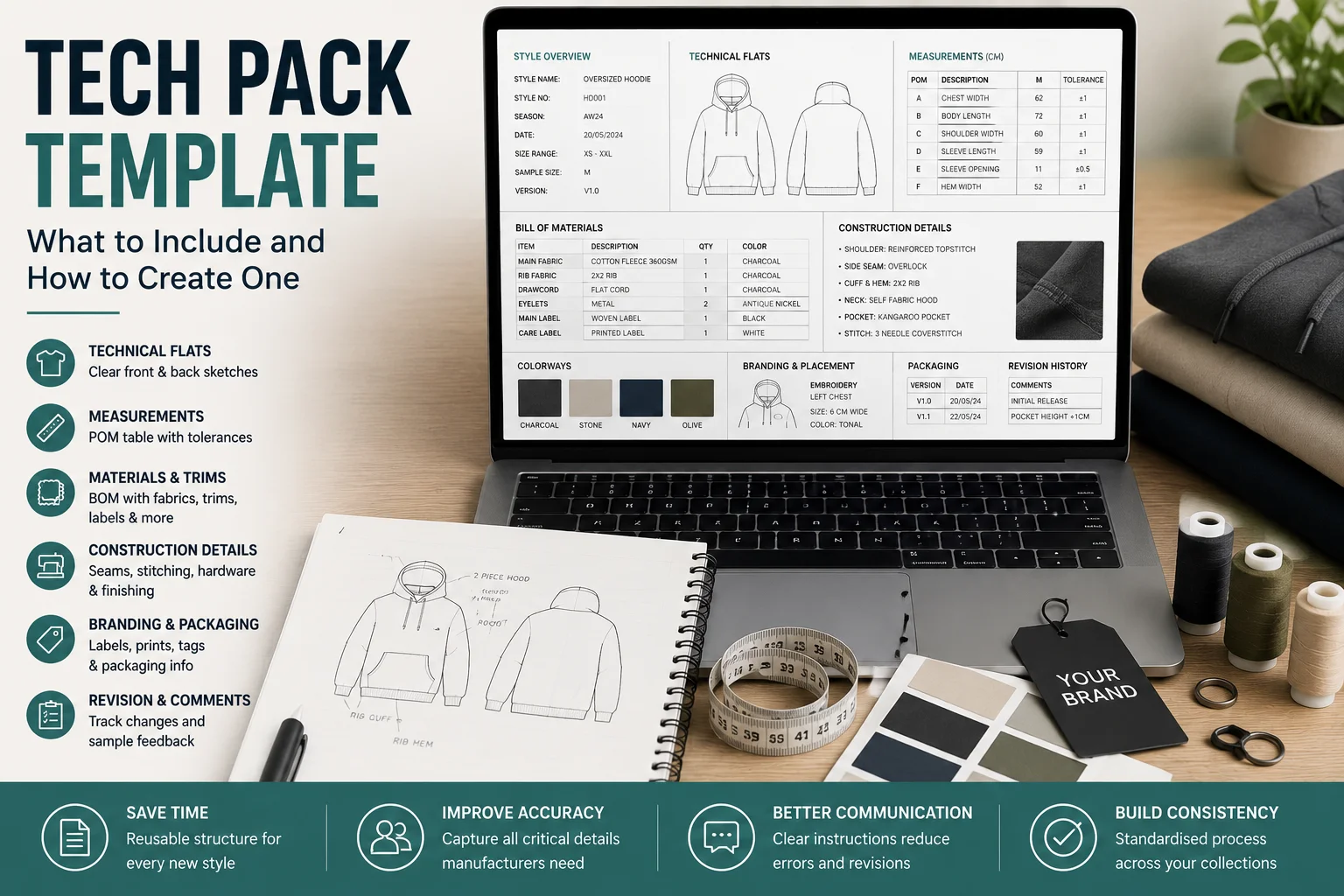
A typical fashion tech pack includes technical drawings, measurements, fabrics, trims, colour information, construction notes, size specifications and a bill of materials. Depending on the product and brand, it can also include packaging requirements, costing information, sample comments and revision history.
Understanding how these documents work is useful not only for experienced fashion designers but also for anyone planning to start a clothing brand, develop a private-label collection or manufacture an original product.
Tech Pack Meaning in Simple Terms
The simplest tech pack meaning is:
A tech pack is a document that tells a manufacturer exactly how to make your product.
It takes a creative idea and translates it into production language.
For example, saying:
“I want an oversized black hoodie with a premium feel.”
gives a manufacturer an idea of what you want, but it leaves dozens of unanswered questions.
What fabric should be used?
What should the fabric weight be?
How oversized should the hoodie actually be?
What is the chest measurement?
How wide should the ribbed cuffs be?
What thread colour should be used?
Should the hood be lined?
What type of drawcord should be fitted?
Where should the brand label sit?
What stitching should be used at the seams?
A good tech pack answers questions like these before production begins.
That is why a tech pack is much closer to an engineering document than a mood board.
Why Is a Tech Pack Important?
One of the most expensive mistakes a new clothing brand can make is assuming that a manufacturer will automatically understand the designer’s intentions.
Manufacturers are skilled at producing garments, but they cannot read the designer’s mind.
If important information is missing, the factory must either ask questions or make assumptions.
Those assumptions may result in a sample with the wrong fit, fabric, pocket position, stitching, colour or finishing.
A detailed clothing tech pack reduces that uncertainty.
Its main purpose is to create a common reference point between the brand and manufacturer.
When both parties are looking at the same measurements, materials and construction instructions, there is less room for interpretation.
Industry guidance consistently identifies reduced production errors and clearer communication as two of the main benefits of using detailed tech packs.
This can make the sampling process more efficient and help a brand move towards bulk production with greater confidence.
What Does a Tech Pack Include?
There is no single universal page count that every tech pack must follow.
A simple T-shirt may need a relatively small pack, while a technical jacket with multiple fabrics, zips, pockets and performance features may require far more detail.
However, most professional tech packs contain several core elements.
1. Cover Page and Basic Product Information
The first page usually identifies the product.
It may contain:
- brand name
- product or style name
- style number
- product category
- season or collection
- date
- designer or developer
- colourways
- sample size
- version number
This information may sound administrative, but version control is particularly important.
Imagine sending version three of a tech pack to a factory, then making several measurement changes and issuing version four.
If the factory accidentally produces from version three, the sample may be made according to outdated specifications.
Clearly identifying each revision helps prevent this.
2. Technical Flat Sketches
Technical drawings, often called fashion flats or technical flats, are among the most recognisable parts of a tech pack.
Unlike fashion illustrations, which may emphasise style and presentation, technical flats are designed to communicate construction.
They usually show the garment laid flat from the front and back.
Complex products may also require side views, inside views and enlarged drawings of specific details.
For example, a jacket flat might show:
the collar shape, zip position, pocket placement, seam lines, cuffs, hem, panels and stitching.
Annotations or callouts can then explain particular construction details.
Current industry guides recommend clear front and back technical drawings, along with close-up views where important features cannot be communicated clearly in the main sketch.
3. Measurement Specification Sheet
A garment cannot be manufactured consistently without measurements.
The measurement section is therefore one of the most important parts of a fashion tech pack.
It normally includes different points of measure, often shortened to POM.
For a T-shirt, these could include:
chest width, body length, shoulder width, sleeve length, sleeve opening and neck width.
Each measurement needs to explain precisely where and how it should be taken.
That level of detail matters.
“Body length” might sound obvious, but a factory still needs to know exactly where measurement begins and ends.
A measurement specification might look something like this:
| Point of Measure | Medium | Tolerance |
|---|---|---|
| Chest width | 56 cm | ±0.5 cm |
| Body length | 72 cm | ±0.7 cm |
| Shoulder width | 49 cm | ±0.5 cm |
| Sleeve length | 24 cm | ±0.5 cm |
| Sleeve opening | 19 cm | ±0.5 cm |
These figures are only an illustrative tech pack example, not recommended measurements for a particular garment.
What Does Tolerance Mean in a Tech Pack?
Garment manufacturing involves physical materials, cutting, sewing and finishing, so achieving exactly the same measurement down to an unlimited level of precision is unrealistic.
A tolerance defines how much variation is acceptable.
If a chest measurement is specified as:
56 cm ± 0.5 cm
then a finished measurement between 55.5 cm and 56.5 cm may be considered acceptable.
Without tolerance information, disagreements can arise about whether a finished garment meets the agreed specification.
4. Bill of Materials
The Bill of Materials, usually abbreviated to BOM, lists the materials and components required to make the product.
Think of it as the garment’s ingredient list.
For a hoodie, the BOM might include:
main fabric, rib fabric, drawcord, eyelets, sewing thread, neck label, size label, care label, swing tag and packaging.
Each component may include detailed information such as:
material composition, weight, colour, supplier, reference code, placement and quantity.
A BOM helps ensure that the manufacturer understands not only the garment shape but also exactly what should go into it.
Industry tech-pack guidance describes fabrics, trims, labels, thread and hardware as typical items documented within the BOM.
5. Fabric Specifications
Writing “cotton fabric” is rarely enough for professional production.
Different cotton fabrics can feel, stretch, shrink and perform very differently.
A useful fabric specification can therefore include:
fibre composition, fabric type, weight, colour, finish, stretch, supplier and reference number.
For example:
Main fabric: 100% cotton, single jersey, 220 GSM, black.
GSM means grams per square metre and is commonly used to indicate fabric weight.
A lightweight summer T-shirt and a heavyweight streetwear T-shirt could both be made from cotton while feeling completely different because their fabric constructions and weights vary.
That is why material descriptions need to be specific.
6. Colourways
If a garment will be produced in several colours, the tech pack should show how each colourway works.
Suppose the same hoodie is available in:
black, stone, navy and forest green.
The garment colour is not the only detail that may change.
Thread, zips, drawcords, labels, prints and embroidery could also differ.
A colourway page makes those combinations clear.
Rather than simply writing “green”, brands may use recognised colour standards or precise supplier colour references when colour consistency is particularly important.
7. Construction Details
A drawing shows where garment features appear.
Construction notes explain how those features should be made.
They may specify:
seam types, stitch types, stitch density, seam allowance, edge finishing, reinforcement, pocket construction, zip installation and hemming.
Consider a pocket.
A sketch can show its location, but the manufacturer may still need to know its dimensions, fabric, opening width, edge finish and stitching.
That is why successful tech packs combine visual information with written instructions.
8. Trims and Hardware
Trims are components added to the main fabric.
Depending on the product, these can include:
buttons, zips, snaps, hooks, eyelets, elastic, drawcords, buckles and decorative elements.
Each should be identified clearly.
For a zip, for example, the manufacturer may need to know:
zip type, length, colour, material, puller style and supplier.
Leaving something as simple as a zip unspecified can change the appearance and perceived quality of the entire garment.
9. Labels and Branding
A clothing tech pack should also communicate how branding should appear on the finished product.
This may include:
main brand label, size label, care label, composition label, embroidery, printed logo, woven patch or transfer.
Placement is just as important as design.
Instead of simply saying “place logo on chest”, the tech pack might show its exact width and its position relative to the centre front, neckline or seam.
Technical drawings can be used to communicate these positions visually.
10. Artwork and Print Specifications
Products containing graphics need additional information.
Suppose a T-shirt has a printed design on the back.
The factory may need:
the artwork file, print dimensions, print position, colour references and printing technique.
Different methods such as screen printing, embroidery, heat transfer and direct-to-garment printing can produce noticeably different results.
A tech pack should therefore identify the intended technique where it has already been decided.
11. Size Grading
A sample garment is usually developed in one base size first.
Once that fit has been approved, the design needs to be expanded into the other sizes.
This process is known as grading.
A grading specification explains how measurements increase or decrease between sizes.
For example:
| Size | Chest Width |
|---|---|
| XS | 50 cm |
| S | 53 cm |
| M | 56 cm |
| L | 59 cm |
| XL | 62 cm |
Again, these values are illustrative only.
Grading is not always a matter of increasing every measurement by the same amount. Different parts of the garment can require different grade rules to maintain the intended proportions.
Tech Pack vs Spec Sheet: Are They the Same?
The terms are sometimes used interchangeably, which can cause confusion.
A spec sheet usually focuses primarily on technical measurements and specifications.
A tech pack is broader.
The measurement sheet can be one section inside the overall tech pack, alongside drawings, materials, construction details, colourways and other production information.
Current fashion-production guidance makes the same distinction: a specification or measurement sheet is a component of the wider production package rather than necessarily being the complete package itself.
The easiest way to remember it is:
Spec sheet = measurements and specifications
Tech pack = complete production instructions
Tech Pack vs Fashion Sketch
A fashion sketch communicates the design concept.
A tech pack communicates how to manufacture that concept.
Imagine a designer draws a beautiful oversized jacket.
The fashion illustration may successfully communicate the silhouette, colours and aesthetic.
But it may not tell the manufacturer:
the exact jacket length, fabric weight, seam construction, pocket measurements, zip specification or lining composition.
The technical pack fills that gap.
This does not make the creative sketch unimportant. It simply serves a different purpose.
Tech Pack vs Pattern
A tech pack is also not the same as a sewing pattern.
The pattern contains the actual shapes used to cut the fabric pieces.
The tech pack communicates the product specifications and construction requirements.
A pattern maker may use the information in the tech pack to create or adjust the pattern.
The two documents therefore work together during product development but are not interchangeable.
A Simple Tech Pack Example
Imagine you are developing a heavyweight unisex T-shirt.
The design looks straightforward, but your tech pack example could still contain several pages.
Page 1: Style Overview
Style name: Core Heavyweight Tee
Style number: CT-001
Sample size: M
Fit: Oversized
Colourway: Black
Page 2: Technical Flats
Front and back technical drawings showing:
neck rib, shoulder seams, sleeves, side seams and hem.
Page 3: Fabric
Main body:
100% cotton
Single jersey
240 GSM
Black
Neck rib:
Cotton/elastane rib
Matching black
Page 4: Measurements
Chest width: 58 cm
Body length: 73 cm
Shoulder: 52 cm
Sleeve length: 25 cm
Each measurement would also include its method and tolerance.
Page 5: Construction
Double-needle hem
Reinforced shoulder seam
Ribbed crew neckline
Specified seam allowance
Page 6: Branding
Main woven label at centre back neck.
Care label inserted into the left inside seam.
Printed logo positioned on the upper back according to supplied artwork dimensions.
Even a relatively simple garment therefore requires more production information than its appearance initially suggests.
How Does a Tech Pack Move Through Production?
A tech pack is not necessarily created once and then forgotten.
It often evolves throughout development.
The first version communicates the initial specifications to the manufacturer.
The manufacturer then creates a sample.
The designer or product developer reviews that sample and identifies changes.
Perhaps the sleeve is too long.
Maybe the neckline needs to be narrower.
The pocket could be positioned slightly higher.
The fabric might need more weight.
Those changes should be documented in the updated tech pack.
A new sample can then be produced against the revised specifications.
This process continues until the product reaches the required standard.
Sample and fit feedback are commonly included as part of the development documentation so that revisions can be tracked rather than relying on disconnected messages.
Why Revision History Matters
Imagine the factory has received these three versions:
Version 1 – original design
Version 2 – changed chest and sleeve measurements
Version 3 – changed fabric and pocket position
Now imagine the designer sends an email saying:
“Please use the measurements from the last sample but use the pocket position from before.”
That kind of communication quickly becomes difficult to manage.
A controlled revision process keeps the latest approved specifications in one place.
A revision log could state:
V1: Initial submission
V2: Chest increased by 2 cm
V3: Pocket raised by 1.5 cm and fabric changed
V4: Final sample approved
Clear version management becomes increasingly important as a brand develops multiple styles simultaneously.
Who Creates a Fashion Tech Pack?
A fashion tech pack may be created by a:
fashion designer, technical designer, garment technologist, product developer or experienced clothing-product specialist.
Larger businesses often have dedicated technical teams responsible for converting creative designs into production specifications.
A small clothing brand may initially create its own tech packs or work with a freelance technical designer.
Industry guidance notes that responsibility often depends on company size: larger brands may use dedicated technical designers, while smaller companies and founders sometimes manage the process themselves.
Can You Create Your Own Tech Pack?
Yes.
Someone starting a clothing brand can learn to prepare a basic tech pack, particularly for relatively simple garments.
However, the document needs to be technically accurate.
A beautifully designed PDF with incorrect measurements or vague construction instructions is not a good tech pack.
If you understand your product well, you can begin by developing:
clear technical drawings, material specifications, measurement tables, colour information and construction notes.
For more complicated products, working with an experienced technical designer or garment technologist can reduce mistakes.
The more technically demanding the garment becomes, the more important specialist knowledge becomes.
If you want to build one from scratch, start with a structured tech pack template that includes measurements, materials, construction details, labels and revision tracking.
What Software Is Used to Create Tech Packs?
There is no single programme that every fashion brand uses.
Traditional workflows commonly combine vector-design software for technical drawings with spreadsheets for measurements and BOMs.
Dedicated tech-pack and product-development platforms can also bring drawings, specifications and revisions into one system.
The important point is not which software you choose.
The factory ultimately needs information that is:
clear, accurate, complete and easy to interpret.
A sophisticated tool cannot compensate for missing technical knowledge.
Likewise, a well-structured spreadsheet and properly prepared technical drawings can be extremely useful when the information is accurate.
Can You Make a Tech Pack Without Adobe Illustrator?
Yes.
Illustrator is widely used for professional technical flats, but it is not the definition of a tech pack.
The purpose of the document is communication.
Various vector-design tools, specialised tech-pack platforms and other design applications can produce suitable technical drawings.
For a professional manufacturing workflow, however, your drawings should remain clean, measurable and easy for the manufacturer to understand.
What Makes a Good Clothing Tech Pack?
A good clothing tech pack answers questions before the factory needs to ask them.
That does not mean adding endless text.
It means providing the right information with enough precision.
A strong pack is usually:
clear enough that another person can understand the design without the creator standing beside them;
specific enough that major details are not left to factory interpretation;
consistent so that measurements, drawings and written notes do not contradict one another;
and current so that the manufacturer knows which revision is approved.
A document containing conflicting information can actually create more confusion than a shorter but well-controlled pack.
Common Tech Pack Mistakes
New brands often concentrate on appearance while missing manufacturing details.
One common problem is providing beautiful sketches without measurements.
Another is using vague fabric descriptions such as “premium cotton” rather than identifying composition, construction and weight.
Missing tolerances can cause disputes over finished measurements.
Poor labelling of revisions can result in outdated instructions being used.
Other problems include forgetting the back view of a garment, failing to specify print placement, leaving trims undefined or changing details through email without updating the master document.
The underlying problem is usually the same:
the factory has been forced to guess.
A good tech pack aims to remove unnecessary guessing from production.
Does a Tech Pack Guarantee a Perfect First Sample?
No.
Even a detailed tech pack does not guarantee that the first sample will be perfect.
Product development is an iterative process.
Fabric behaviour, pattern balance, finishing and fit can all require adjustments after seeing the physical garment.
The tech pack gives the factory a much stronger starting point, but sampling still exists because some decisions are easier to evaluate on an actual product than on a screen.
The first sample may therefore reveal that the product needs refining.
The difference is that a clear tech pack makes those corrections easier to identify, document and communicate.
Is a Tech Pack Only for Clothing?
No.
Although the term is strongly associated with fashion, technical production packs can also be used for:
footwear, bags, accessories, textile products and other manufactured goods.
For example, a handbag tech pack may specify:
materials, dimensions, hardware, stitching, lining, straps and branding.
A footwear pack can include:
upper materials, outsole details, construction, colours, components and size information.
Tech-pack specialists also describe the format as useful beyond apparel wherever a repeatable manufactured product requires detailed specifications.
Do You Need a Tech Pack Before Contacting a Manufacturer?
You can contact manufacturers before your tech pack is complete, particularly when you are researching capabilities, minimum order quantities, lead times or available materials.
But before requesting an accurate sample or production quotation, detailed specifications become much more important.
A manufacturer cannot quote accurately if it does not know what it is expected to produce.
A plain cotton T-shirt and a heavyweight T-shirt with embroidery, custom labels, specialised dyeing and premium packaging might look like the same product category but have very different production costs.
The tech pack gives the manufacturer enough information to understand what the quotation actually needs to cover.
Frequently Asked Questions
What is a tech pack in fashion?
A tech pack is a detailed production document used by designers and manufacturers to communicate how a garment should be made. It normally includes technical drawings, measurements, materials, trims, construction details and other product specifications.
What does tech pack mean?
Tech pack means technical package. It is essentially the production blueprint for a clothing or manufactured product.
What is included in a clothing tech pack?
A typical clothing tech pack includes style information, technical flat sketches, measurement specifications, tolerances, fabrics, trims, a bill of materials, colours, construction notes, labels, artwork details and size information. More complex products may require additional pages.
Is a tech pack the same as a spec sheet?
Not exactly. A spec sheet generally focuses on measurements and specifications, while a tech pack contains the broader set of information required for production. The spec sheet can form one part of the overall tech pack.
Do I need a tech pack to start a clothing brand?
A detailed tech pack is highly useful once you begin developing custom products with manufacturers. It reduces ambiguity and helps communicate exactly what you want produced.
Can a beginner create a fashion tech pack?
Yes, particularly for simple products. However, measurements, material information and construction details need to be accurate. Complex garments may benefit from the experience of a technical designer or garment technologist.
How many pages should a tech pack have?
There is no fixed number. A simple garment may require only several pages, while complicated outerwear, footwear or accessories may require a much larger technical package.
Does a tech pack include pricing?
It can. Some tech packs or connected product-development documents contain costing sheets, though the exact structure differs between brands and manufacturers. Costing is listed among common tech-pack components in current industry guidance.
What is a BOM in a tech pack?
BOM stands for Bill of Materials. It lists the fabrics, trims, labels, hardware and other components required to manufacture the product.
When should a tech pack be updated?
It should be updated whenever an approved product specification changes. Measurements, materials, construction details, artwork or other revisions should be reflected in the latest controlled version.
Final Thoughts
So, what is a tech pack?
At its core, it is the document that turns a fashion idea into clear manufacturing instructions.
A drawing can show what you want a garment to look like. A fashion tech pack explains how that garment should actually be produced.
It brings together measurements, materials, technical flats, trims, colours, construction details and other specifications so that the designer and manufacturer can work from the same information.
For anyone learning the tech pack meaning, the easiest way to think about it is as a product blueprint.
A detailed clothing tech pack cannot remove every challenge from product development, and it does not eliminate the need for sampling. What it does is reduce uncertainty. It gives manufacturers a much clearer starting point and gives the brand a written reference against which samples and production can be checked.
That makes the tech pack one of the most useful documents in the journey from an idea on paper to a garment that can be produced consistently.