




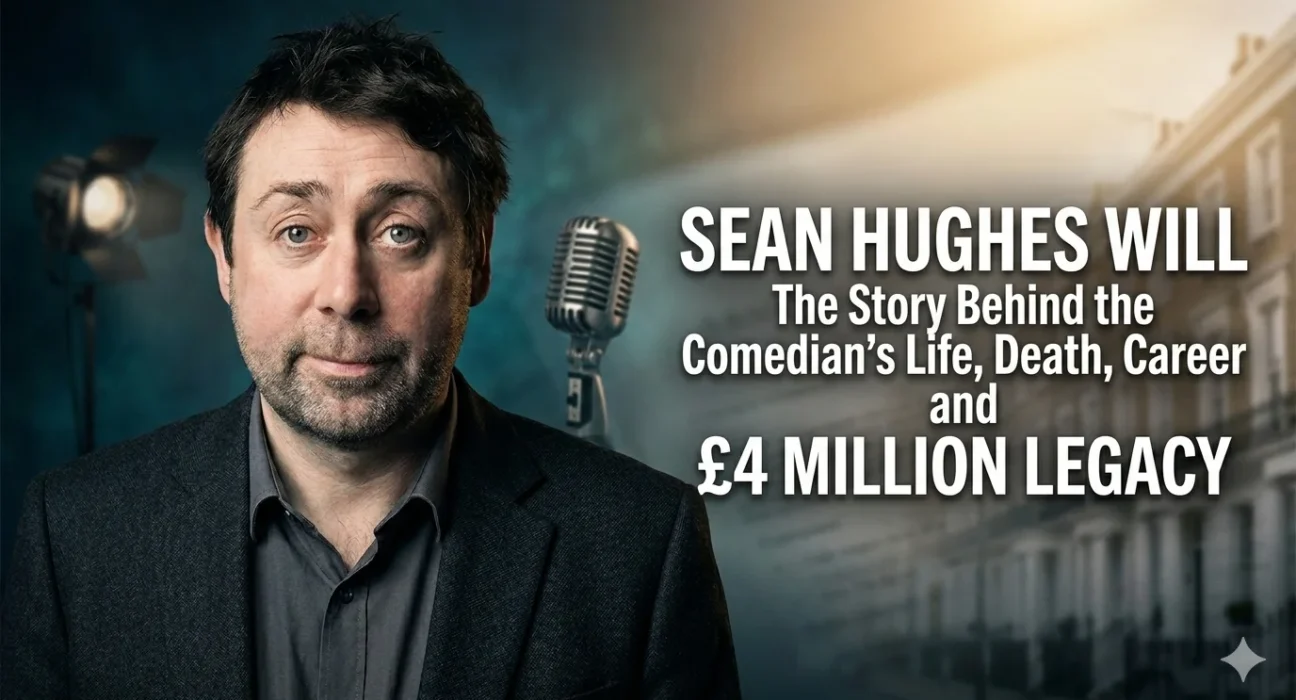
Sean Hughes Will: The Story Behind the Comedian’s Life, Death, Career, and £4 Million Legacy
Reviewed and last updated on August 13, 2026 by admin
Sean Hughes was one of the most distinctive comedians of his generation. Known for his sharp humour, storytelling style, television work, poetry, and novels, he built a career that went far beyond a typical stand-up routine. Years after his death, the Sean Hughes will has brought renewed attention to his life because his estate was at the centre of a major legal case involving a generous gift to the homelessness charity Shelter.
For many people, Sean Hughes will always be remembered as the quick-witted team captain from Never Mind the Buzzcocks. Others knew him from his cult Channel 4 sitcom Sean’s Show, his Edinburgh Fringe performances, or his books and poetry. His final legacy, though, has become just as meaningful as his comedy — his decision to leave his property portfolio to Shelter reflected a deep concern for people facing homelessness and housing insecurity.
| Quick Bio | Details |
|---|---|
| Full name | John “Sean” Hughes |
| Known as | Sean Hughes |
| Profession | Comedian, writer, actor, poet, novelist, radio presenter |
| Date of birth | 10 November 1965 |
| Place of birth | Archway, North London, England |
| Nationality | British-born Irish |
| Raised in | Dublin, Ireland |
| Date of death | 16 October 2017 |
| Age at death | 51 |
| Cause of death | Cardiac arrest complicated by cirrhosis of the liver, per contemporary reports |
| Spouse | Never married |
| Children | None publicly confirmed |
| Net worth | No verified public figure available |
| Estate value | Reported at nearly £4 million |
| Major TV work | Sean’s Show, Never Mind the Buzzcocks, The Last Detective |
| Major achievement | Youngest Perrier Award winner at the time, aged 24 |
| Legacy beneficiary | Shelter, the UK homelessness charity |
| Will ruling | High Court, March 2026 |
Who Was Sean Hughes?
Sean Hughes was a British-born Irish comedian, writer, actor, and poet whose work left a strong mark on UK and Irish comedy. Although born in London, he moved to Dublin as a child and spent much of his early life there — a mix of London and Dublin culture that shaped his accent, humour, and perspective.
He was never simply a joke teller. He had an unusual ability to make audiences laugh while also making them think, moving between absurd observations, emotional honesty, self-deprecation, literary references, and long personal stories. At a time when most stand-up was built around separate jokes, Hughes developed a more connected storytelling style — shows with character, place, mood, and emotional movement — which helped him become one of the important voices in the growth of modern long-form stand-up. He was also highly respected by fellow comedians as an original performer who brought something more layered to the stage.
Early Life and Background
Hughes was born on 10 November 1965 in Archway, North London, to Irish parents with roots in Cork and Dublin. Around the age of six, his family moved to Ireland, and he grew up mainly in Dublin.
His childhood wasn’t always easy — he later spoke about feeling out of place at school because of his London accent, and that sense of not fully fitting in became part of his creative identity. Rather than hiding it, he turned awkwardness and social discomfort into material audiences could relate to.
He attended Coláiste Éanna in Dublin, where he began making people laugh and reportedly arranged comedy performances at school — the early foundation of his career. His work was shaped by Irish storytelling, London energy, working-class humour, and a strong interest in books, poetry, and music, which is why it often felt different from the louder comedy styles of the period.
Breakthrough: The Perrier Award
Hughes began performing stand-up in the late 1980s, part of the growing alternative comedy scene, and performed at venues including the Comedy Store in London.
His major breakthrough came in 1990 at the Edinburgh Festival Fringe, where his show A One Night Stand with Sean Hughes won the Perrier Award for Best Show. At 24, he became the youngest winner of the award at the time. The show stood out for using an imaginative setting and a complete narrative rather than a string of unrelated jokes — Hughes built a world for the audience to enter, showing that stand-up could have structure and emotional depth without losing its humour. The win brought UK-wide attention and opened doors to television, acting, books, and radio.
Sean’s Show and Television Career
Sean’s Show, Hughes’s Channel 4 sitcom, aired in the early 1990s and featured him playing a fictionalised version of himself. It was unusual for its time in regularly breaking the fourth wall — Hughes would speak directly to the audience or comment on being in a television show — a self-aware style that made it a cult favourite, playful and different from more conventional British sitcoms.
For many viewers, though, Hughes became most recognisable through Never Mind the Buzzcocks, joining the BBC music panel show as a team captain in 1996 and remaining a regular part of it until 2002. His calm, almost casual delivery let his quick reactions and sharp wit come through — humour that could look effortless but was carefully observed and precisely timed.
His other television work included The Last Detective, Coronation Street, Casualty, The Commitments, Puckoon, and Round Ireland with a Fridge, along with stage roles including The Railway Children and As You Like It.
Writer, Poet, and Novelist
Hughes had a literary side just as important as his comedy. His novels and poetry showed a quieter, more reflective personality: published books included Sean’s Book, The Grey Area, The Detainees, and It’s What He Would Have Wanted, alongside poetry collections My Struggle to Be Decent and Poems of Sadness and Light.
His writing explored loneliness, relationships, identity, family, sadness, memory, and the strange details of everyday life — themes that also ran through his comedy, sometimes hidden beneath the jokes. He wrote and spoke honestly about his own struggles, including isolation and difficulty with long-term relationships, which gave his work a human quality; his comedy could be dark, but it was rarely cold. He also hosted the podcast Under the Radar, interviewing people from the comedy world.
Death
Sean Hughes died on 16 October 2017, aged 51. Reports at the time said he had been unwell and hospitalised; he suffered a cardiac arrest, with later reporting connecting his death to advanced liver disease and cirrhosis. He had spoken openly at different points about alcohol and his attempts to stop drinking — but his life and legacy shouldn’t be reduced only to the circumstances of his death. His death brought widespread tributes from performers and audiences who remembered his intelligence, warmth, originality, and influence, and his work continues to reach new audiences through clips, books, and television repeats.
The Will and the £4 Million Shelter Legacy
The Sean Hughes will became a major public story nearly a decade after his death. Hughes intended to leave his property assets — a £1.8 million North London home and two further properties worth a combined £2.15 million — to Shelter, the UK homelessness charity.
The complication was that Hughes hadn’t owned all three properties directly: two were held through a company he solely owned, and his handwritten will (drafted without legal assistance, via an online platform) simply referred to “my three houses.” That left an open legal question — did the company shares, and the properties tied to them, pass to Shelter?
The case went to the High Court. In March 2026, Master Iain Pester ruled that the “correct construction of the will” meant the company shares — and therefore the properties — should pass to Shelter. Had the ruling gone the other way, the two company-held properties would have fallen into Hughes’s residuary estate, held in trust for his wider family instead.
Hughes’s family and Shelter had agreed all along that the charity was the intended beneficiary; the court’s involvement was needed only to resolve the will’s ambiguous wording. His family issued a public statement afterward, calling him “a great and generous comedian, but horrible at admin,” and said they hoped the outcome would encourage others to consider people less privileged when making their own plans — “ideally with at least a teeny, tiny bit of legal advice.” They also noted that housing vulnerability had been an issue close to Hughes’s heart, tied to his own experience of housing insecurity when he first moved to London to pursue stand-up, and that he had long admired Shelter’s work — including performing at the charity’s Stand Up for Shelter gig in 2014.
Was Sean Hughes Married?
Hughes never married and spoke publicly about not feeling suited to conventional marriage and family life. He was private about his personal relationships, and there’s no reliable public evidence of a spouse or children — worth noting since online searches sometimes surface unrelated people sharing the same name.
He did have close family ties: two brothers, Alan and Martin, who later spoke publicly about their pride in the charitable outcome of his estate.
Net Worth and Estate Value
There’s no confirmed public net worth figure for Sean Hughes — celebrity net worth estimate sites often lack reliable sourcing and should be treated with caution. What is publicly documented is the estate connected to his will: reported at nearly £4 million, made up of the £1.8 million home and the two additional properties worth £2.15 million combined. That figure reflects property assets tied to the will, not a confirmed lifetime estimate of personal wealth — so it’s more accurate to describe it as his estate value than his net worth.
Why Sean Hughes Still Matters
Hughes changed how many people saw stand-up comedy, showing that a comedian could be funny without being predictable, and that a show could hold emotional depth, storytelling, and vulnerability alongside the laughs. He crossed creative worlds as a comedian, actor, novelist, poet, radio host, and television personality — some people knew him from panel shows, others from his books, others from his surreal television work or live performances. His influence can still be felt in comedians who combine personal storytelling with humour; his style was about making an audience feel they were listening to someone intelligent, honest, and deeply human, not about impressing them with noise.
Frequently Asked Questions
What was Sean Hughes best known for? As a stand-up comedian, writer, and actor, and as a team captain on Never Mind the Buzzcocks. He also starred in his own Channel 4 sitcom, Sean’s Show, and won the Perrier Award at the Edinburgh Festival Fringe in 1990.
How old was Sean Hughes when he died? 51 — he died on 16 October 2017.
What was the cause of death? A cardiac arrest; public reporting later linked his death to serious liver disease and cirrhosis.
Was Sean Hughes married? No — he never married, and no spouse has been publicly confirmed.
What happened to his estate? Hughes intended his property estate to go to Shelter. After a near decade-long legal case over ambiguous wording in his handwritten will, the High Court ruled in March 2026 that the estate assets should pass to the charity.
How much was his estate worth? Reported at nearly £4 million — his £1.8 million home plus two further properties worth a combined £2.15 million. There’s no verified figure for his personal net worth.
Final Thoughts
Sean Hughes was much more than a television comedian — a gifted storyteller, writer, actor, and poet whose work carried emotion and honesty alongside the laughs. The story of his will adds a meaningful final chapter: nearly ten years after his death, his intention to leave his estate to Shelter was honoured through the courts in March 2026, ensuring his generosity continues to support people facing homelessness.